


A "Conductive" Webbing That Can Prevent Factory Explosions? Unveiling the Hidden Tech Secrets Behind Anti-Static Conductive Webbing!
Have you ever considered that a seemingly ordinary work uniform, an inconspicuous wristband, or even a carpet might conceal a "hidden technology" vital to life safety?
In high-risk or high-precision environments like petrochemicals, chip manufacturing, and cleanrooms, static electricity — an invisible "killer" — can lightly attract dust, affecting product yield, or severely trigger combustion and explosion accidents. The anti-static conductive webbing is precisely the key line of defense against it.
Today, we'll unveil the scientific principles, technological breakthroughs, and real-world application scenarios behind this "conductive fabric."
I. What is Anti-Static Conductive Webbing? How is it Different from Ordinary Webbing?
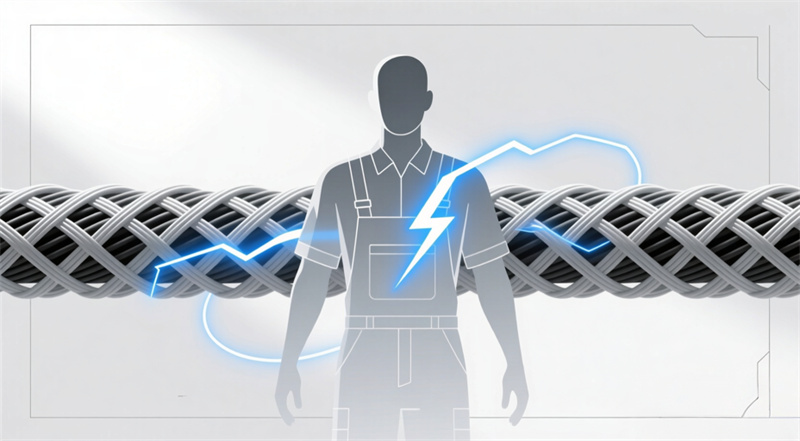
Anti-static conductive webbing is not an ordinary cloth strip, but a functional composite material. It embeds conductive fibers (such as stainless steel wire, carbon fiber, organic conductive polymers, etc.) into the textile structure, forming a continuous conductive network. This network rapidly dissipates static electricity generated by the human body or equipment, preventing charge accumulation.
Different from traditional anti-static agent coatings (easily washed off, short-lived effects), genuine anti-static conductive webbing adopts the "inlaid weaving" process — conductive fibers are directly woven into the fabric as warp or weft yarns, achieving durable anti-static performance. Even after 50 standard washes, its surface resistance can remain stable below 1×10⁹Ω, far superior to the requirements of the Chinese national standard GB12014-2009.
✅ Key Performance Indicators:
Charge Density ≤ 0.6 μC/m² (National Standard upper limit: 7 μC/m²)
Friction Voltage < 500V
Static Half-Life ≤ 5 seconds
Wash Durability ≥ 20 cycles (Performance degradation < 15%)
II. Technological Breakthrough: From "Blending" to "Inlaid Weaving" – How has the Webbing Become Lighter, Thinner, and More Reliable?
Early anti-static fabrics often used simple blending of conductive fibers with ordinary yarns, which suffered from discontinuous conductive paths, stiff handfeel, and easy breakage.
In 2024, the industry witnessed a major innovation — the official implementation of the patented Inlaid Weaving Technology:
Warp yarns adopt a 1:1 arrangement of casein-modified acrylic yarn + metal plied yarn;
Weft yarns use mohair loop yarn to maintain fabric breathability and loftiness;
Conductive fibers are precisely embedded at a density of 15–25 threads/cm (warp) and 10–20 threads/cm (weft);
A "two up, two down" nodal weave structure forms on the surface, creating a stable conductive network.
The result? Webbing thickness reduced by 30%, weight dropped to 280g/㎡, while elastic recovery reached 3.5N·cm/kg — truly lightweight, durable, and achieving "comfortable wear, complete protection."
III. More Than Just Workwear: Three Major Application Scenarios of Anti-Static Webbing
1. Industrial Protection Field
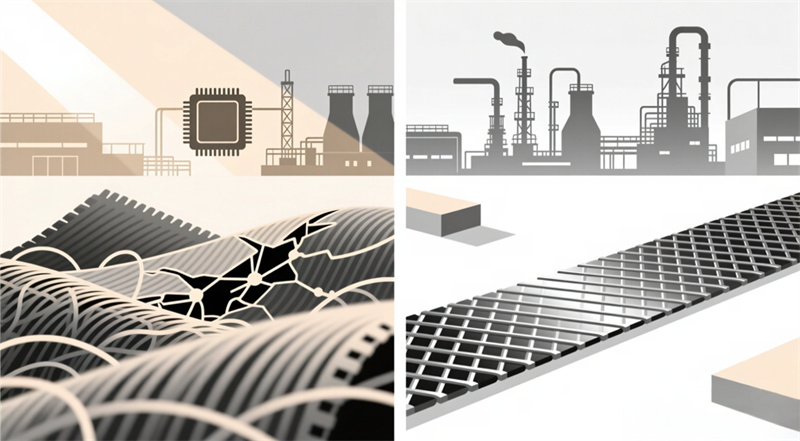
In flammable and explosive environments like petroleum, chemical plants, and LPG stations, workers wearing protective clothing containing anti-static webbing can effectively prevent electrostatic sparks from causing explosions. For example, a Tianjin LPG station once had an accident caused by static accumulation. After fully adopting inlaid-woven anti-static suits, the accident rate dropped to zero.
2. Precision Manufacturing & Cleanrooms
In semiconductor, LCD panel, and pharmaceutical cleanrooms (Class 10–100), static electricity attracts micro-dust, causing product defects. Workwear, shoe covers, and wristbands made from anti-static webbing can reduce dust attraction due to static by over 90%, significantly improving product yield.
3. Civilian & Home Textiles
Your anti-static carpet, anti-static blanket, or even business suits may incorporate conductive webbing technology. For example, TR (polyester/rayon) anti-static fabrics increase moisture regain to 8.5%, eliminating "crackling" discharges while wearing and preventing "flyaway hair" when removing clothes in winter.

IV. How to Identify Genuine "Anti-Static Conductive Webbing"?
The market is flooded with products. Some rely only on surface-coated anti-static agents, losing effectiveness after a few washes. Here are three tips to discern the genuine from the fake:
Look at the Color: High-quality conductive webbing is often dark silver-gray due to the metal fibers.
Check the Resistance: Use a multimeter to measure the resistance across the wristband or webbing ends. It should be between 10³–10⁶Ω (too low poses an electric shock risk, too high is ineffective).
Demand Certification: Look for test reports complying with international and domestic standards like GB12014-2009 and IEC61340-5-1.
Conclusion
A small strip of webbing carries not only the advancement of textile technology but also the pursuit of safety, efficiency, and a comfortable life. From factories to laboratories, from workshops to living rooms, anti-static conductive webbing silently safeguards our production and daily lives.
🔍 Interactive Question:
Have you used anti-static equipment at work? Have you ever suffered from static electricity?
Feel free to share your experiences or ask questions about selecting compliant anti-static webbing products for your team!
📌 Tip: For industrial-grade anti-static webbing samples or technical specifications, message us to receive the 2026 latest product catalog (including resistance test videos).
Keywords Covered: Anti-static conductive webbing, Anti-static webbing, Conductive webbing, Anti-static material, Conductive fabric, Electrostatic protective webbing, Industrial anti-static webbing, Conductive fiber webbing, Static-resistant webbing, Anti-static fabric